
 Griffith University
I am a Lecturer in the School of Information and Communication Technology at Griffith University. I received my PhD from the University of New South Wales (UNSW) in 2019 and was a Research Fellow at UNSW before joining Griffith in 2023.
My research focuses on biomedical AI and computer vision, with particular interests in multimodal biomedical intelligence, 3D/4D vision, predictive spatiotemporal modelling, neuroimaging and brain-signal analysis, computational pathology, cellular imaging and molecular profiling, surgical robotics, and trustworthy AI for healthcare. My work aims to transform complex biomedical and real-world data into actionable intelligence, supporting biomedical discovery, disease understanding, precision healthcare, and intelligent robotic assistance.
I have published in leading venues including Nature Methods, IEEE TPAMI, IEEE TMI, and CVPR, among others. I received the Australian Pattern Recognition Society Early Career Research Award in 2023. I co-found and currently co-lead the AI4Health Lab.
News
Selected Publications (Read more )
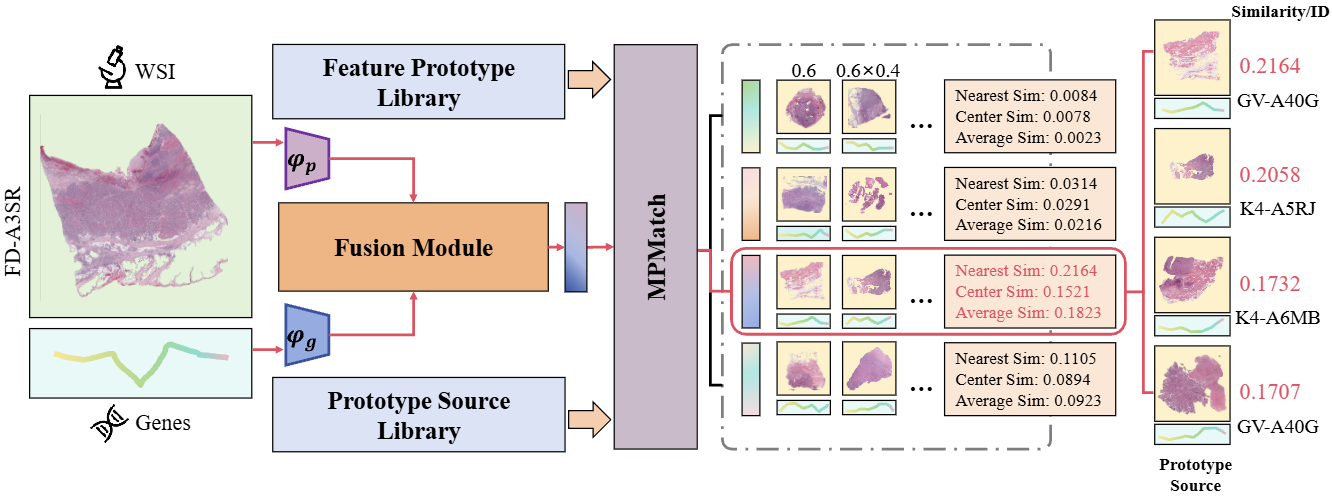
Multimodal Feature Prototype Learning for Interpretable and Discriminative Cancer Survival Prediction
IEEE Journal of Biomedical and Health Informatics 2026 JCR Q1
This work improves cancer survival prediction by linking histopathological patterns with genomic information in an interpretable prototype-learning framework. Beyond predictive accuracy, it provides transparent patient-level evidence of the tumour phenotypes associated with survival outcomes, supporting more trustworthy prognosis and personalised decision-making.
Multimodal Feature Prototype Learning for Interpretable and Discriminative Cancer Survival Prediction
IEEE Journal of Biomedical and Health Informatics 2026 JCR Q1
This work improves cancer survival prediction by linking histopathological patterns with genomic information in an interpretable prototype-learning framework. Beyond predictive accuracy, it provides transparent patient-level evidence of the tumour phenotypes associated with survival outcomes, supporting more trustworthy prognosis and personalised decision-making.
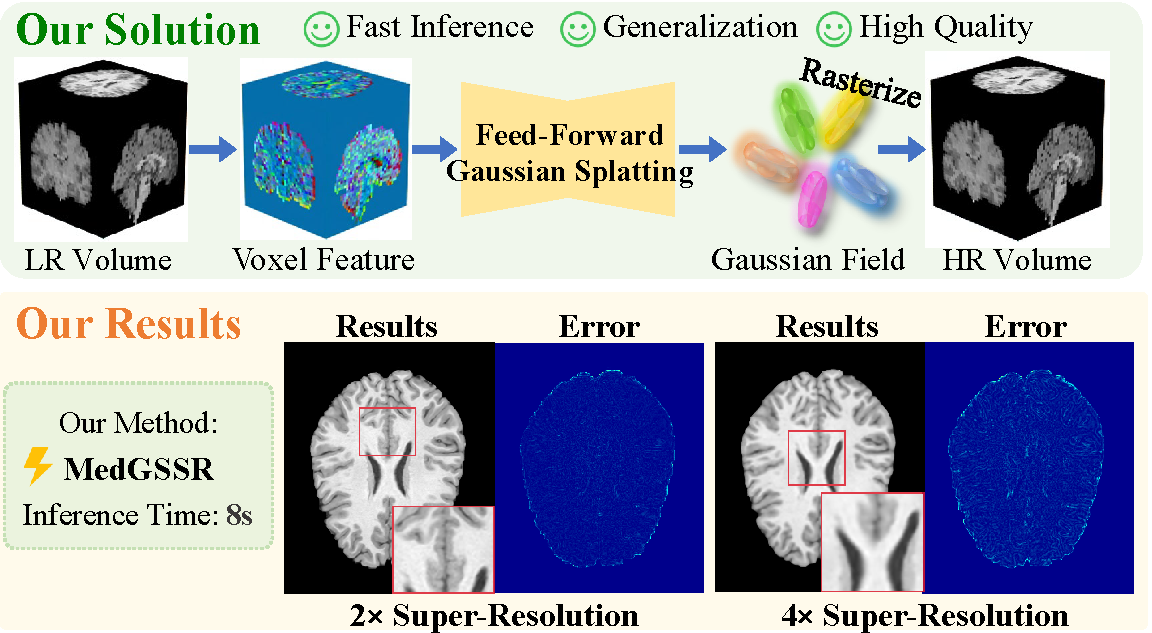
MedGSSR: Generalizable Medical Image Super-Resolution 3D Reconstruction via Hierarchical Feed-forward Gaussian Splatting
European Conference on Computer Vision (ECCV) 2026 CORE A* CCF-B
This work develops MedGSSR, an end-to-end feed-forward framework for arbitrary-scale 3D medical image super-resolution. By representing MRI and CT volumes with explicit 3D Gaussian fields, it enables fast, anatomically faithful, and high-detail reconstruction while generalising to unseen datasets without per-subject optimisation.
MedGSSR: Generalizable Medical Image Super-Resolution 3D Reconstruction via Hierarchical Feed-forward Gaussian Splatting
European Conference on Computer Vision (ECCV) 2026 CORE A* CCF-B
This work develops MedGSSR, an end-to-end feed-forward framework for arbitrary-scale 3D medical image super-resolution. By representing MRI and CT volumes with explicit 3D Gaussian fields, it enables fast, anatomically faithful, and high-detail reconstruction while generalising to unseen datasets without per-subject optimisation.
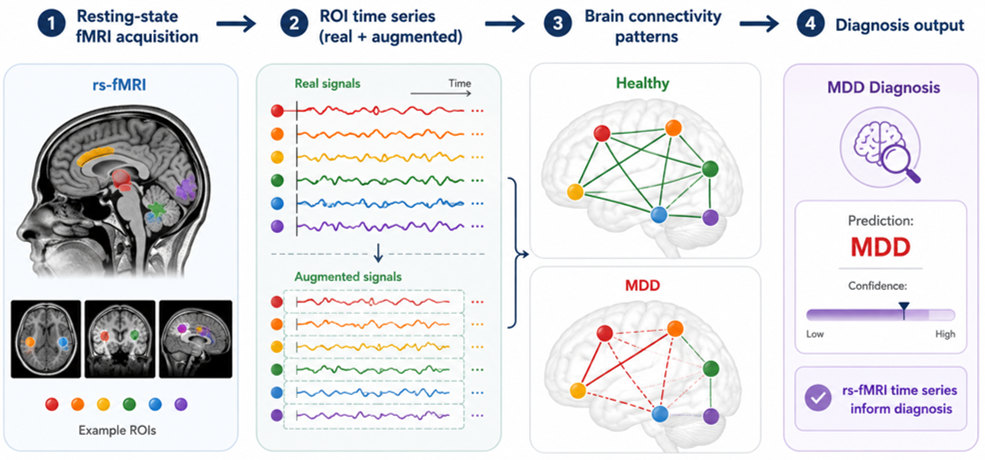
fMRI-Diffusion: Generating fMRI Time Series Via a Temporal Transformer Diffusion Model for Major Depressive Disorder Diagnosis
Submitted to Computer Methods and Programs in Biomedicine. Under review. JCR Q1
This work proposes a generative framework for synthesizing resting-state fMRI time series to improve Major Depressive Disorder diagnosis. It provides a practical data augmentation strategy for limited neuroimaging datasets while preserving clinically meaningful temporal brain activity patterns.
fMRI-Diffusion: Generating fMRI Time Series Via a Temporal Transformer Diffusion Model for Major Depressive Disorder Diagnosis
Submitted to Computer Methods and Programs in Biomedicine. Under review. JCR Q1
This work proposes a generative framework for synthesizing resting-state fMRI time series to improve Major Depressive Disorder diagnosis. It provides a practical data augmentation strategy for limited neuroimaging datasets while preserving clinically meaningful temporal brain activity patterns.
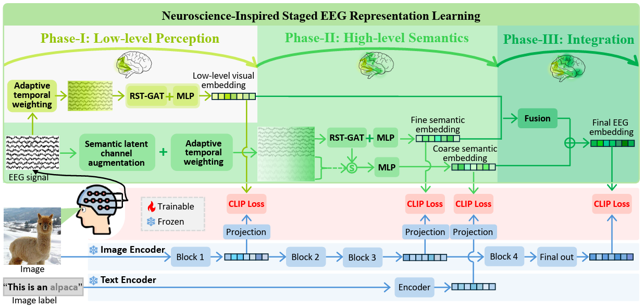
Neuroscience-inspired Staged Representation Learning with Disentangled Coarse-and Fine-Grained Semantics for EEG Visual Decoding
Submitted to Neurocomputing. Under review. JCR Q1
This work improves EEG-based visual decoding by modelling how the human visual system processes information in stages. This enables more accurate and robust zero-shot visual decoding, supporting brain-computer interfaces, neural signal interpretation, and AI-assisted neurorehabilitation.
Neuroscience-inspired Staged Representation Learning with Disentangled Coarse-and Fine-Grained Semantics for EEG Visual Decoding
Submitted to Neurocomputing. Under review. JCR Q1
This work improves EEG-based visual decoding by modelling how the human visual system processes information in stages. This enables more accurate and robust zero-shot visual decoding, supporting brain-computer interfaces, neural signal interpretation, and AI-assisted neurorehabilitation.
SR3R: Rethinking Super-Resolution 3D Reconstruction With Feed-Forward Gaussian Splatting
The 43th IEEE/CVF Conference on Computer Vision and Pattern Recognition (CVPR) 2026 CORE A* CCF-A
This work enables feed-forward and generalisable 3D super-resolution reconstruction from low-resolution multi-view images, avoiding costly per-scene optimisation. By learning a direct mapping to high-resolution 3D Gaussian representations, SR3R can reconstruct unseen scenes efficiently while improving visual detail, geometric consistency, and cross-scene generalisation.
SR3R: Rethinking Super-Resolution 3D Reconstruction With Feed-Forward Gaussian Splatting
The 43th IEEE/CVF Conference on Computer Vision and Pattern Recognition (CVPR) 2026 CORE A* CCF-A
This work enables feed-forward and generalisable 3D super-resolution reconstruction from low-resolution multi-view images, avoiding costly per-scene optimisation. By learning a direct mapping to high-resolution 3D Gaussian representations, SR3R can reconstruct unseen scenes efficiently while improving visual detail, geometric consistency, and cross-scene generalisation.
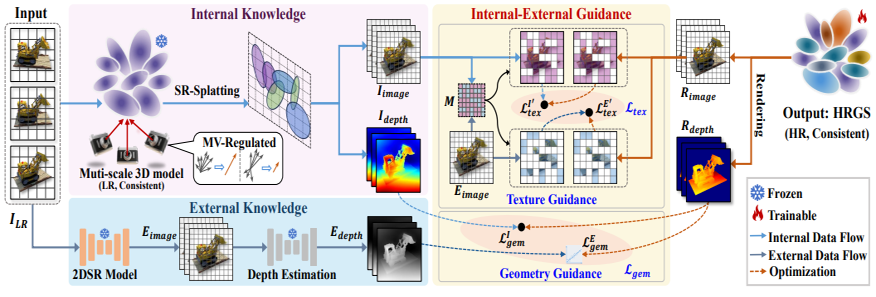
IE-SRGS: An Internal-External Knowledge Fusion Framework for High-Fidelity 3D Gaussian Splatting Super-Resolution
The 40th Annual AAAI Conference on Artificial Intelligence (AAAI) 2026 CORE A* CCF-A
This work enables high-fidelity 3D reconstruction from low-resolution inputs, improving both visual quality and geometric consistency. It introduces a 3D Gaussian Splatting super-resolution framework that fuses external 2D super-resolution and depth priors with internal multi-scale 3DGS representations.
IE-SRGS: An Internal-External Knowledge Fusion Framework for High-Fidelity 3D Gaussian Splatting Super-Resolution
The 40th Annual AAAI Conference on Artificial Intelligence (AAAI) 2026 CORE A* CCF-A
This work enables high-fidelity 3D reconstruction from low-resolution inputs, improving both visual quality and geometric consistency. It introduces a 3D Gaussian Splatting super-resolution framework that fuses external 2D super-resolution and depth priors with internal multi-scale 3DGS representations.
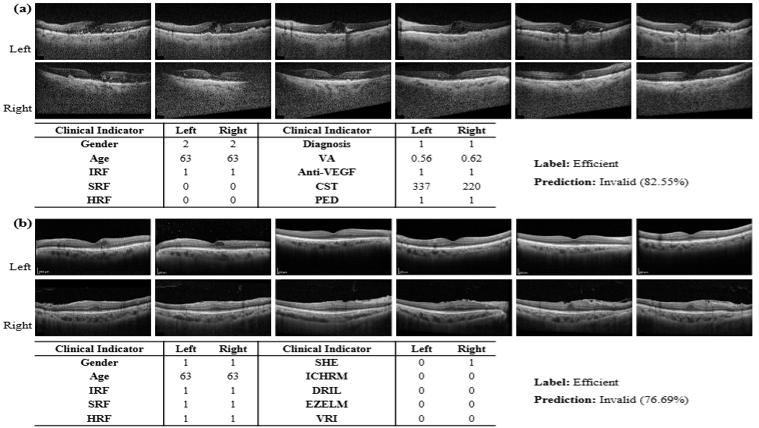
MVTT-GMamba: A Multimodal Graph Reasoning Framework for Anti-VEGF Efficacy Prediction in Diabetic Macular Edema
IEEE Journal of Biomedical and Health Informatics 2026 JCR Q1
We propose a multimodal AI solution that combines OCT images and clinical indicators to predict Anti-VEGF treatment response in diabetic macular edema. This work supports more personalised ophthalmic care by helping clinicians anticipate treatment efficacy and make better informed therapeutic decisions.
MVTT-GMamba: A Multimodal Graph Reasoning Framework for Anti-VEGF Efficacy Prediction in Diabetic Macular Edema
IEEE Journal of Biomedical and Health Informatics 2026 JCR Q1
We propose a multimodal AI solution that combines OCT images and clinical indicators to predict Anti-VEGF treatment response in diabetic macular edema. This work supports more personalised ophthalmic care by helping clinicians anticipate treatment efficacy and make better informed therapeutic decisions.
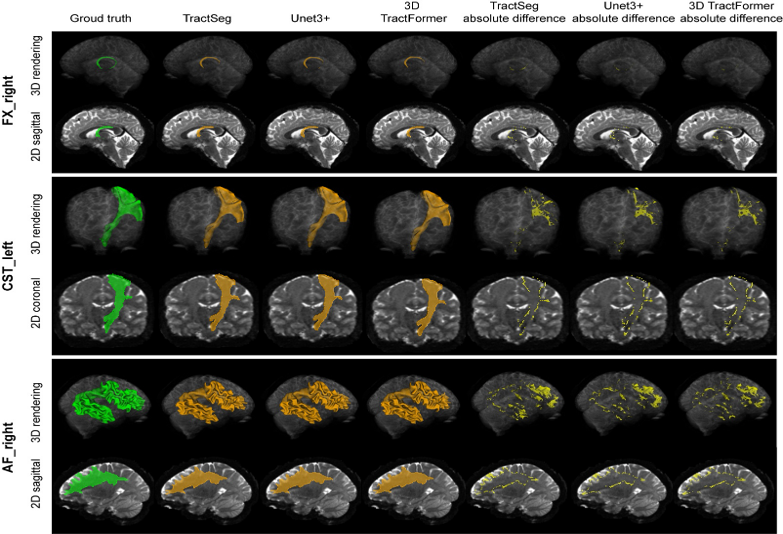
AC-UNet: Adaptive Connection UNet for White Matter Tract Segmentation Through Neural Architecture Search
IEEE 21th International Symposium on Biomedical Imaging (ISBI) 2024 ERA2010 Core A
This work develops AC-UNet for accurate white matter tract segmentation in diffusion MRI. It enables more accurate delineation of complex brain fiber pathways, and supports downstream applications in neurodegenerative disease analysis, brain injury assessment, and surgical planning.
AC-UNet: Adaptive Connection UNet for White Matter Tract Segmentation Through Neural Architecture Search
IEEE 21th International Symposium on Biomedical Imaging (ISBI) 2024 ERA2010 Core A
This work develops AC-UNet for accurate white matter tract segmentation in diffusion MRI. It enables more accurate delineation of complex brain fiber pathways, and supports downstream applications in neurodegenerative disease analysis, brain injury assessment, and surgical planning.
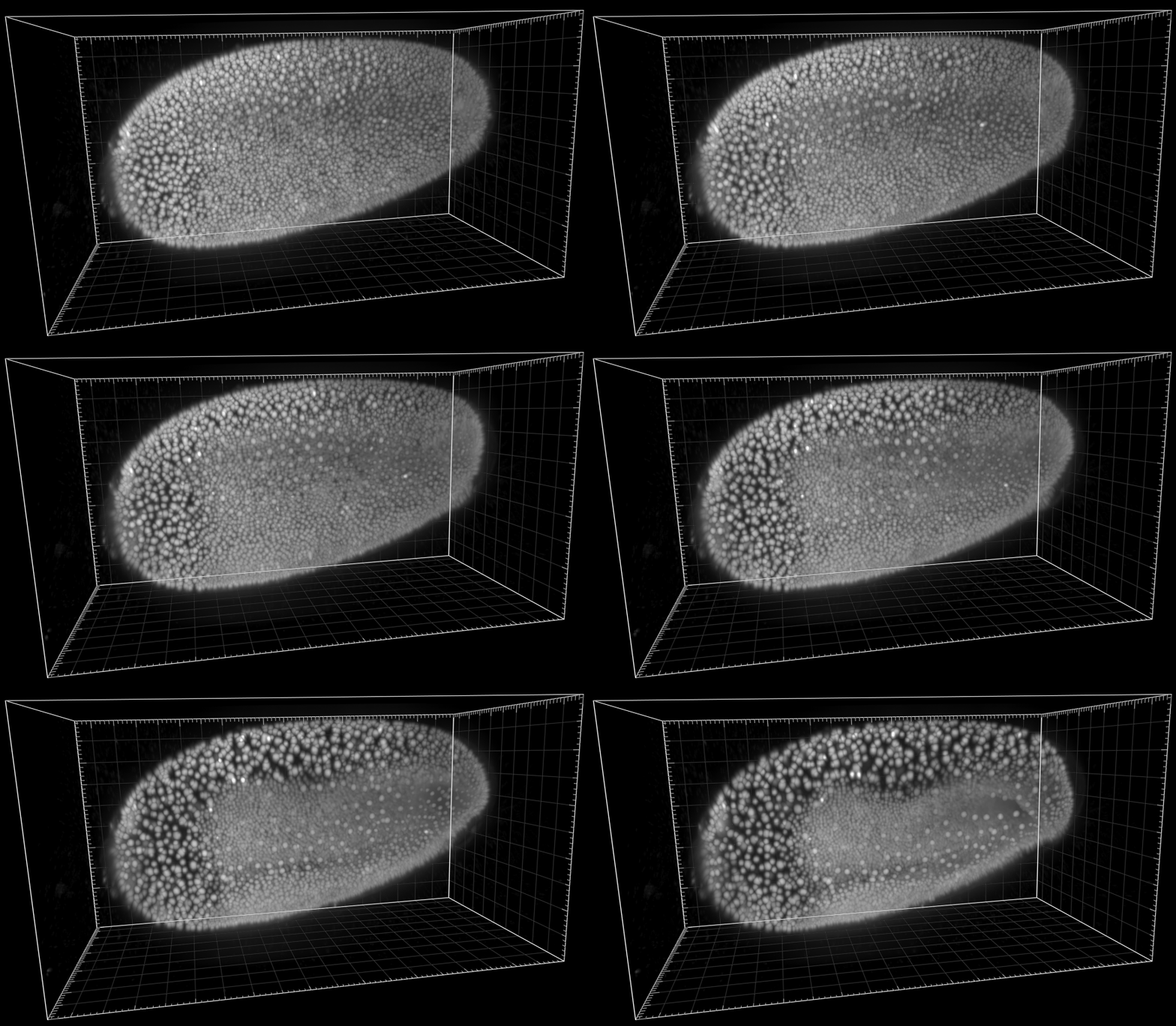
The cell tracking challenge: 10 years of objective benchmarking
Nature Methods 2023 JCR Q1
This work contributes to the benchmarking infrastructure of bioimage analysis by systematically evaluating cell segmentation and tracking algorithms across diverse microscopy datasets. It supports the development of more robust, generalizable, and reusable methods for large-scale biological image analysis.
The cell tracking challenge: 10 years of objective benchmarking
Nature Methods 2023 JCR Q1
This work contributes to the benchmarking infrastructure of bioimage analysis by systematically evaluating cell segmentation and tracking algorithms across diverse microscopy datasets. It supports the development of more robust, generalizable, and reusable methods for large-scale biological image analysis.
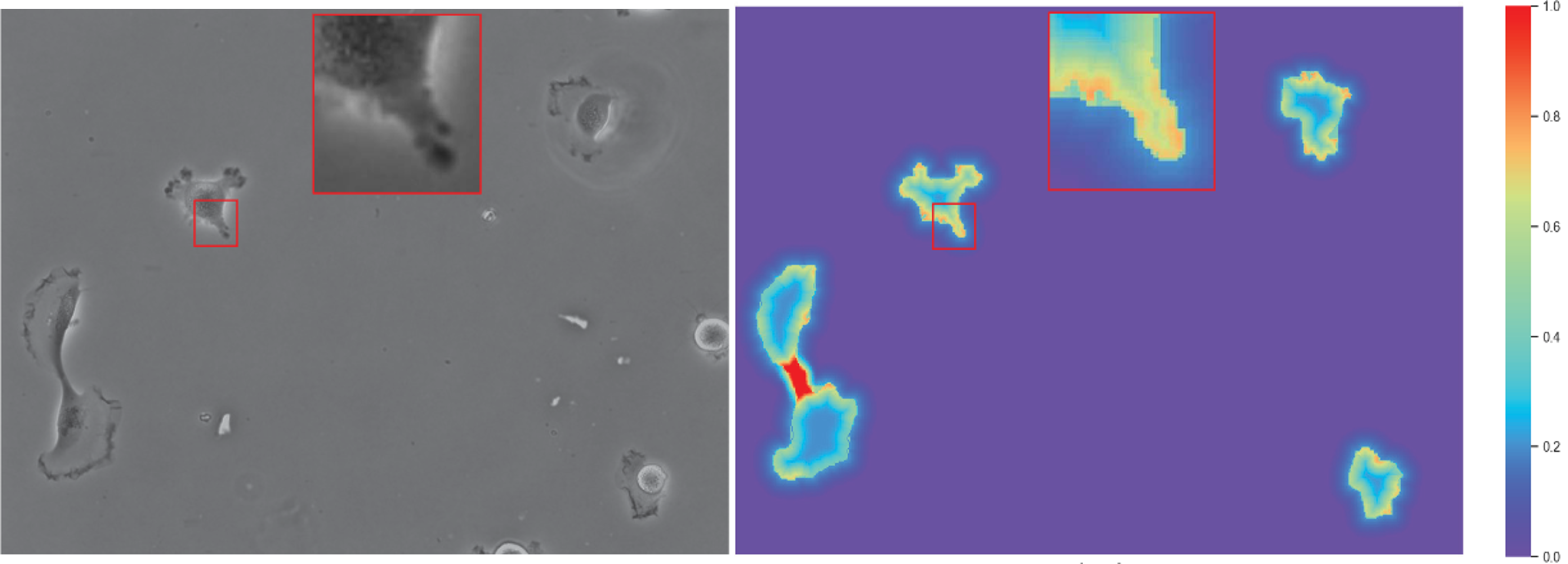
A compound loss function with shape aware weight map for microscopy cell segmentation
IEEE Transactions on Medical Imaging 2022 JCR Q1
This work develops a shape-aware compound loss function for microscopy cell segmentation. It improves segmentation accuracy by guiding deep models to better capture cell boundaries, subtle cell structures, and challenging regions with missing or imbalanced annotations.
A compound loss function with shape aware weight map for microscopy cell segmentation
IEEE Transactions on Medical Imaging 2022 JCR Q1
This work develops a shape-aware compound loss function for microscopy cell segmentation. It improves segmentation accuracy by guiding deep models to better capture cell boundaries, subtle cell structures, and challenging regions with missing or imbalanced annotations.
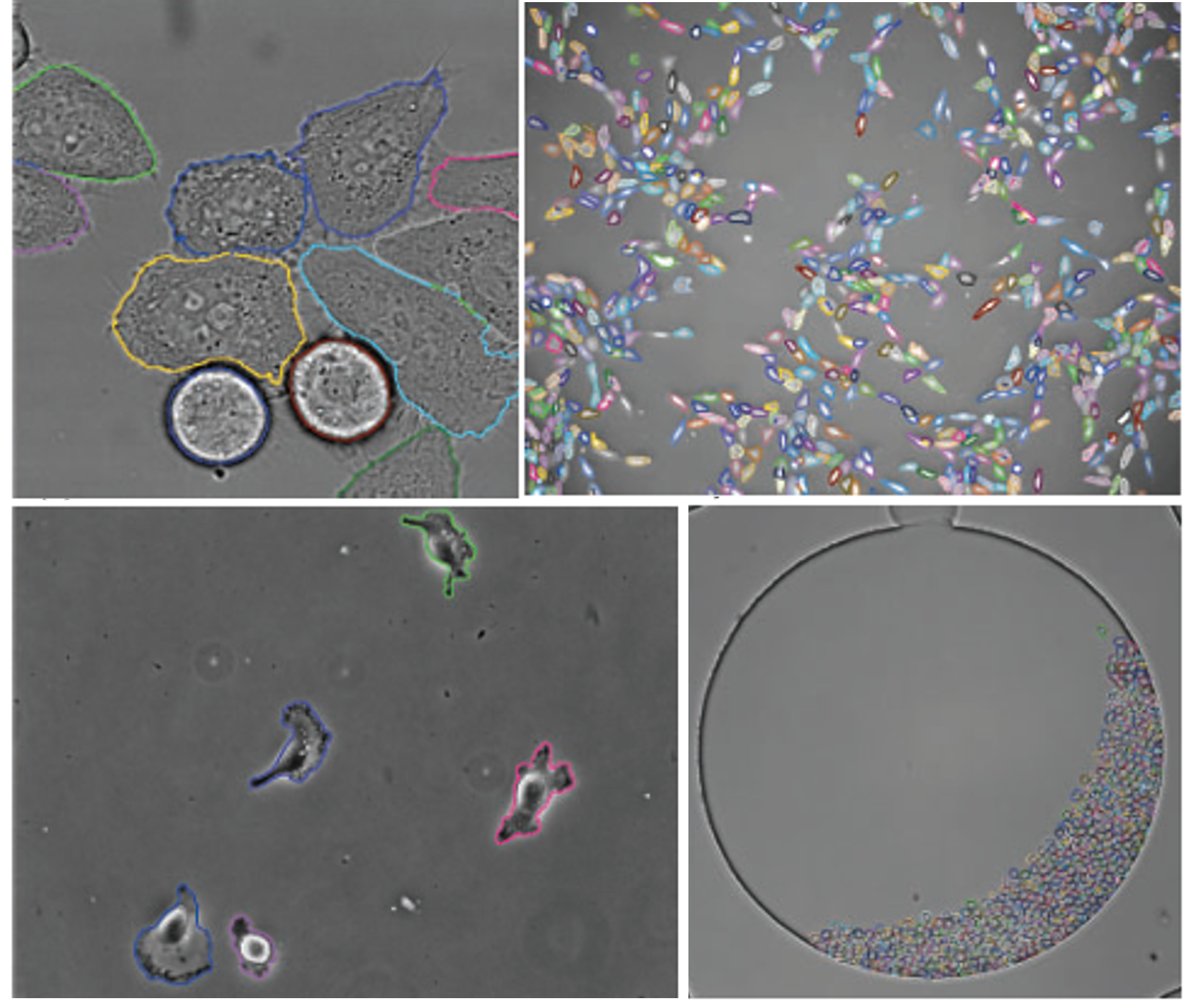
Automatic improvement of deep learning-based cell segmentation in time-lapse microscopy by neural architecture search
Bioinformatics 2021 JCR Q1
This work develops an automated neural architecture search method for live cell segmentation in time-lapse microscopy. It designs task-specific networks that exploit both spatial and temporal information, achieving robust performance across diverse microscopy cell datasets.
Automatic improvement of deep learning-based cell segmentation in time-lapse microscopy by neural architecture search
Bioinformatics 2021 JCR Q1
This work develops an automated neural architecture search method for live cell segmentation in time-lapse microscopy. It designs task-specific networks that exploit both spatial and temporal information, achieving robust performance across diverse microscopy cell datasets.
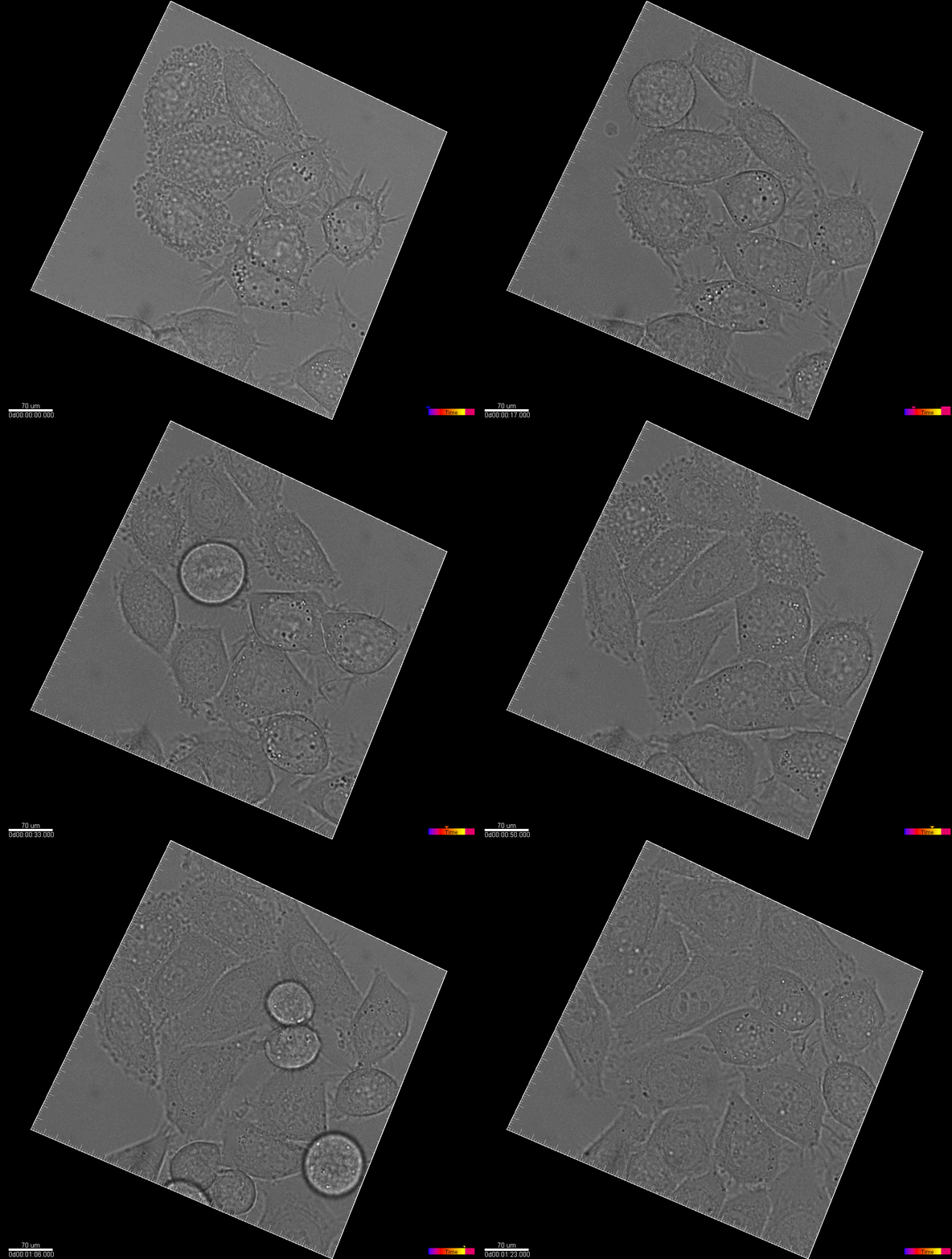
Neural architecture search for microscopy cell segmentation
International Workshop on Machine Learning in Medical Imaging 2020
This work applies neural architecture search to microscopy cell segmentation. It automatically optimizes U-Net and UNet++ based architectures using task-specific network blocks, improving segmentation performance while reducing manual network design effort.
Neural architecture search for microscopy cell segmentation
International Workshop on Machine Learning in Medical Imaging 2020
This work applies neural architecture search to microscopy cell segmentation. It automatically optimizes U-Net and UNet++ based architectures using task-specific network blocks, improving segmentation performance while reducing manual network design effort.
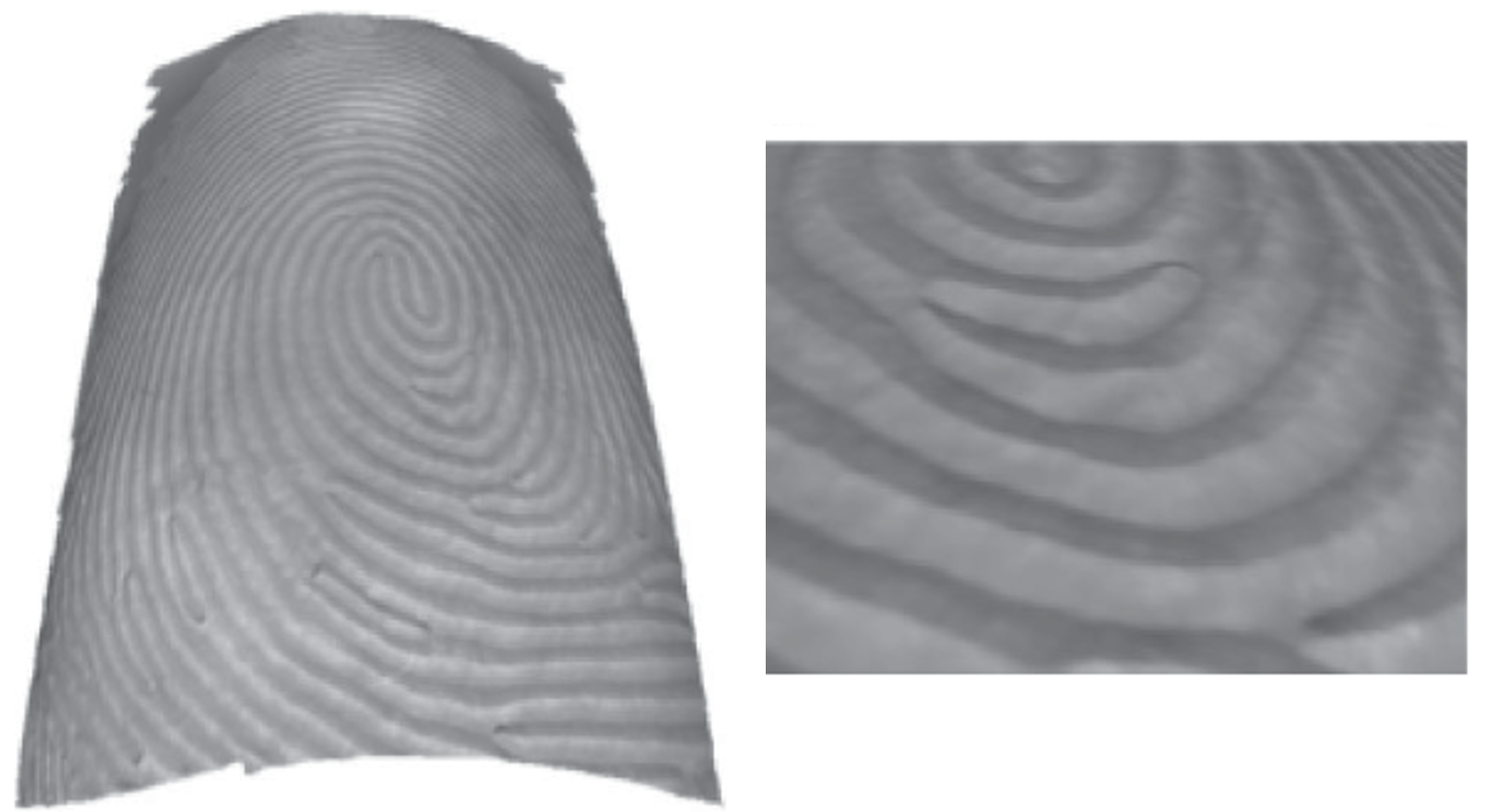
3D fingerprint recognition based on ridge-valley-guided 3D reconstruction and 3D topology polymer feature extraction
IEEE Transactions on Pattern Analysis and Machine Intelligence 2019 JCR Q1
This work develops a real-time 3D fingerprint recognition method that combines ridge-valley-guided reconstruction with 3D topology polymer features. It improves both reconstruction quality and recognition accuracy, supporting practical and contactless biometric authentication.
3D fingerprint recognition based on ridge-valley-guided 3D reconstruction and 3D topology polymer feature extraction
IEEE Transactions on Pattern Analysis and Machine Intelligence 2019 JCR Q1
This work develops a real-time 3D fingerprint recognition method that combines ridge-valley-guided reconstruction with 3D topology polymer features. It improves both reconstruction quality and recognition accuracy, supporting practical and contactless biometric authentication.